Monday, 21 April 2014

Welcome new MTC President & Sister Robison

Our mission president invited the Robison's, the new MTC President and his wife as well as the other senior missionary couples, down to experience some of the sights in this area. First, we went to the  Elmina Slave Castle.
                                                                                                                                   
President & Sister Robison

The center courtyard of the fort


The Elmina Castle is a fort originally built by the Portuguese in 1471 for the protection of their trading interests in West Africa. Soon after, trading came to include slaves.
School children on the ramparts of the fort


Years passed and the fort was captured by the Dutch. It was later sold to the English. For over 400 years slaves were captured and sent off to the America's, England or elsewhere. The chiefs sold non-compliant villagers, or sent warriors out to abduct members of warring tribes, selling to the traders for Western goods.


Original bricks, worn smooth by the bare feet of innumerable slaves, are still visible in some of the rooms. There were no sleeping or toilet facilities. When asked about why they didn't take better care, and protect their "assets" we were told they wanted only the strongest
ones .... those that survived the "castle" and the voyage.


Areas where powerful events take place have a spirit about them. There is a very tangible spirit in the Tabernacle or Conference Center on Temple Square in Salt Lake City. A contrasting spirit exists at the WWII concentration camps and other locations where horrible events took place. The "castle" had such an oppressive feeling, evidence that terrible atrocities took place here.


There were separate quarters for male and female slaves. Food was scarce, and fresh water was in short supply. We listened gravely as our guide gave a description of the  deplorable living conditions in the dungeon.


Room of no return


The captives that were not compliant and caused problems were put in this small room, where they
were left to die. No one ever got out alive.


Bars and doors were everywhere. Except, of course, in the governors section, the soldiers quarters, and the two churches that were eventually built within the fort.


When the ships arrived,  slaves were directed through this door, never to see their homes and families again. More people died in the castle than those exiting the door, and often, more people died during the voyage than those who arrived. The death toll over the four centuries in West African slave castles and on the ships they left in, was higher than WWII concentration camps and the Russian Gulags combined.


This would have been the view as they departed the exit door. Today, this picture shows African fishing boats and not a slave ship, but the views is the same.


The saddest thought is that "slave castles" such as this were all along the coast of Western Africa. Just to the West and within sight of this fort is the Cape Coast Castle, which is of comparable size.


This memorial plaque  speaks for itself.


Next, on a much happier and adventurous note, the couples went to the Canopy Walkway, part of the Kakum protected Rain Forest. 


The senior couples (we still cringe at being referred to as a "senior" couple) get together every few months for an activity, although not all of them are as extensive as this one. So don't get the impression that we are here on vacation.

This is the traditional "picture by the sign" that everyone was taking, although our pose was a little different .... imagine that.


When we got there we discovered it was a holiday, and many school children were on the path with us.The little ones would yell "obroni" at us and get all excited. The older ones would pass in teenage coolness.


Sister J. spent a whole lot of time looking down. Sister Schiffman was definitely not looking down. She kept asking Sister J. to sing something calming to her. Elder J. suggested "Nearer My God to Thee", and was met with definite disapproval! Sister Shulz didn't come on the walk
because of acrophobia, but later came with her son and grandkids. We are so proud of her for
     facing her fear of heights.

Looking down!

Elder & Sister Schiffman and Sister Julander walking through the canopy


Just to give you a perspective, the little trees that look like shrubs down below are the size of the largest trees in our neighborhood in Hooper, Utah.


Sister J. swinging on a vine swing. She hit the root below as she let go. Ouch!


                              And now for some random pictures we thought you would enjoy.


This is one of our alarm clocks.... usually going off around 4:30 AM. There are many chickens, roosters and baby chicks of all sizes roaming the streets. Some are quite beautiful.


 Sister J. loves the little goats here. This is a young one, (goat and boy) just about the size of a cat. When we were taking this picture, a woman, wanting to get in on the picture taking event, came over with a cat that was not very happy! Many people here like getting their pictures taken. Then they want to see themselves on the camera.


I'm not sure who was acting crazier, the cat or the woman holding it. She thought we were nuts to take a picture of a goat. Many of the Ghanaian's have a great sense of humor. I know that they like to laugh at us a lot. Sorry I missed her head in the picture but the cat was out of control and she had me laughing so hard....


Couldn't help taking a picture of this little girl....the kids here are so dang cute. Most usually smile these huge, heart melting smiles until you get out the camera. Then they hide and peek out from behind their parents, like this little one. Those that are older love to mug the camera.


 This is a main window in the Accra Ghana LDS Temple. We love the windows at night. Inside, there are marvelous doors, trim and panels from the native mahogany wood.


The Temple is small, but so very beautiful. We get to go there when we visit Accra for transfers (or the occasional truck repair).


This man in the Nkroful branch just returned to Church, and his 4 children are being taught by these wonderful missionaries - Elders Chishinji and Iwuchukwu. Yup, they're difficult for us to pronounce too. We ordained this man an Elder in the last Mission Conference.


This brother has been a member for about 6 months now. He has come to Church faithfully using two sticks to hold himself upright while walking. Two Sunday's ago, we delivered this wheelchair, which we picked up in Accra (another miracle on how that happened). The Church sends the wheelchairs to the Ghana Health Services and they distribute them. If a member is in need of one, they are available for the cost of assembly.

And finally, here is Sister Julander, trying to keep our awesome, Axim  missionaries in line. The missionaries here in Cape Coast are so good ... and strong ... and faithful ... and rule abiding ... etc., etc., etc.  We love them!!!                                                    


Sunday, 23 March 2014

SETTLED IN:

We are becoming more accustomed each day to living here in Ghana. Sister J. usually drives while Brother J. assumes the role of navigator. He's better at navigating and she is a great driver. For a country that loves to hassle drivers - setting speed traps and pulling people over at police stops for no apparent reason - there is an obvious lack of traffic rules and an even greater lack common sense and courtesy. Taxi's and tro tro's (vans that act like small, over-packed buses for public transportation) zoom around, cut in and out of traffic, and are very aggressive. Motorcycles, on the other hand, have absolutely no rules whatsoever. They weave in and out of traffic, run red lights, make right hand turns from the inside left lane and even go the wrong direction at times. Our mission maintenance coordinator pronounced Sister J. an "official Ghanaian driver" when he rode with her. She can be pretty aggressive herself.

We continue to discover places to buy the things we like to eat and use. We've found sellers where we purchase produce, beans, coconut oil (it took us two months to find this one), and several stores that sell "American" goods. We found Nutella, Doritos (made in Saudi Arabia), Newman's Own salad dressing and Costco brand canned chicken. Many items are not consistent, however, and may be available one day and "finished" (meaning they're out) the next, or may never be seen again. So we'd like to share some pictures of the market place where we do a lot of our shopping. It has become one of our favorite places to go and a "goldmine" for picture taking.  Ready? Here we go!


 People eat lots of peppers here. They call them pepe's because they drop the r's at the end of words. These are pretty hot, and for company
we take the seeds out before we use them. They are displayed like this and sold in plastic baggies by some measure we don't quite understand, but we're sure it's different for "obroni's" than for natives. For a sandwich sized bag, the cost is about 50 cents.


These green ones are milder, but we haven't tried them yet....just liked the way the picture turned out.


Here are some peppers graded, separated and ready to sell. The bag is full of something we don't understand. There are several things here we have no clue what it is, how to fix it, or what it tastes like. Adventure awaits!


Above is a display of fabric. There are many tailors - men and women - who sew custom-made African apparel with very bright and colorful Ghanian cloth.

There are stands and shops selling almost everything imaginable. "Market Circle", located in Takoradi has the greatest variety and the best market we've seen.


Since we are on the coast, we see lots and lots of sea food in the market, although we know some of you may take exception to the word "food" associated with some of these creatures. This is fish that has been smoked. They also sell it fresh, fried crispy, or salted & dried. We have eaten some of these things in stews. OK, Elder J. has eaten some of these things in stews.


The merchants stack and arrange their products very nicely. There are a lot of people selling fish, so they try to present them as attractively as pos-
sible. This goes for all the merchants in the market.


             These are sold in the market for food, if they can keep them from crawling away.


        The vendor of these crabs ties them up with rubber bands to keep them in place. This vendor                                             was very nice to let us take pictures of some of her "critters".


These little crabs are sold live. They were skittering around the pan trying to get out. I think they eat them shell and all.


These little shells contain a contorted little creature called a "kiss me and throw me away". They are put in stew or soup, and you pick them up, suck out the little animal inside, and throw away the shell. Thus, the name. An African missionary Sister prepared a stew for us with these in it. Sister J. ate one. Elder J ate three. The stew was really, really good.


We tried to download a video of the market, but we were unsuccessful. We need our son here to help. But it is an experience we rarely get tired of. Why don't you all come over and see for yourselves. We have plenty of room, and you would love the people here. They are so warm and friendly.


Here is a shop that sells beans (pink & black eyed peas), popcorn, flour, peanuts (groundnuts), and many other things. The jars with yellow lids are filled with groundnut paste (100% peanut butter with no salt or sugar added). The owner uses a tin can to measure a set amount of product into a bag for a price that might be higher for obroni's. (they think all whites are rich)


The market circle is lined with shops and with people selling on the sidewalk like these ladies. They put the produce in tin cans and piles for tomatoes and onions, and you buy the ones in the pile or can for a certain price. Every available space is taken by a vendor. If they put another seller on the street, they would be in the way of foot traffic. There are so many vendors there! The sidewalk is also full of vendors carrying produce on their heads who walk around selling their wares. We've also seen cars driving down the overly crowded sidewalks. Pretty crazy!


Both used and new clothing is sold. This is used clothing from Europe & the US that arrives in huge bales and is sold to  vendors sell on the streets.


How many different things for sale can you identify in this picture? Are there some that you don't recognize? Neither do we. 


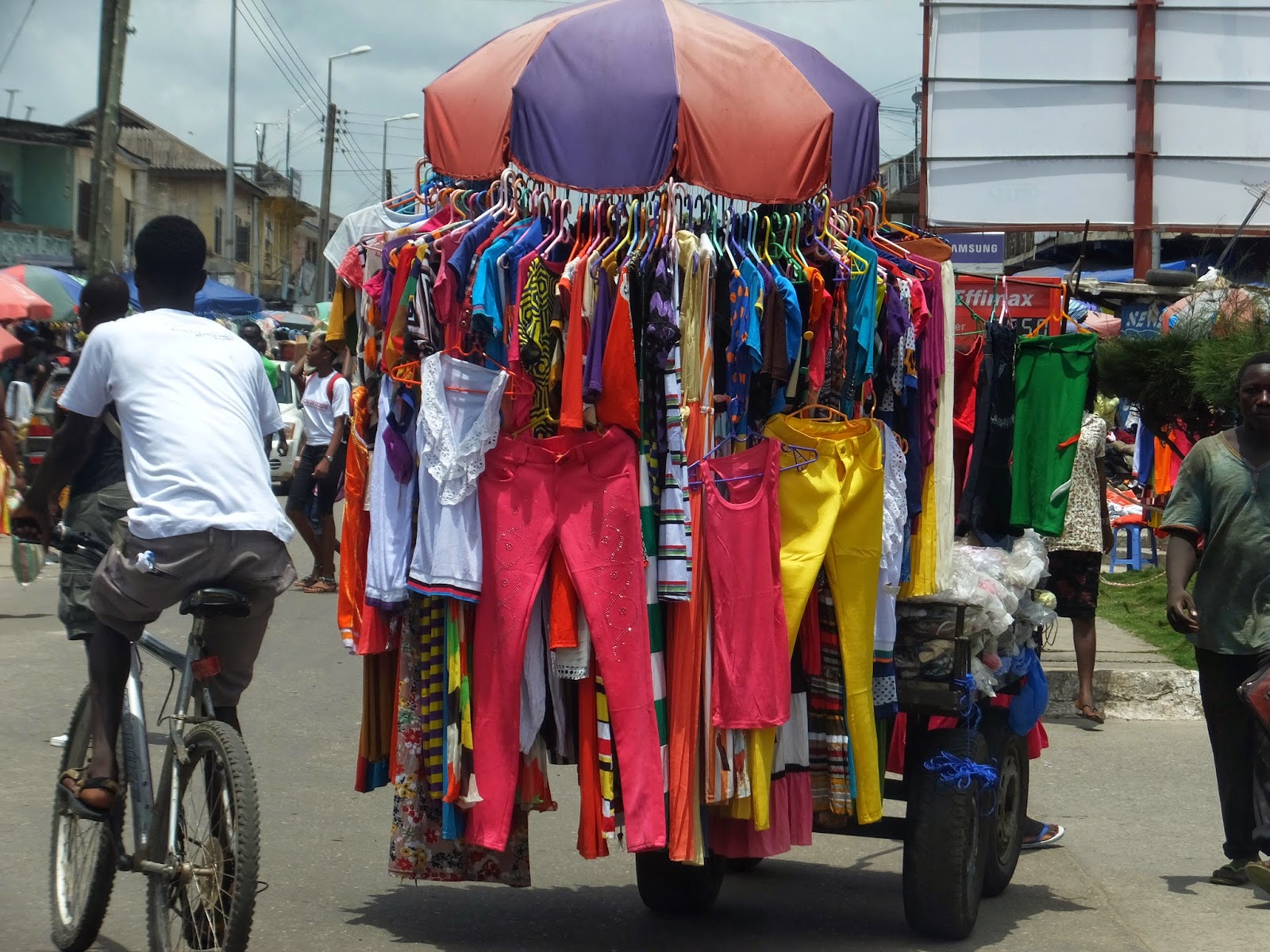
This is a wheeled cart that this vendor has modified into a shop. She was rolling it down the street.


This picture was taken from our truck on the way to Market Circle. Don't ask us how we got there or how long it took. Driving here reminds us of the Bumper Cars at Lagoon, except you don't try to hit other cars, just avoid being hit. No matter how many lanes there are supposed to be, Ghanians will find a way to create one more.


Sister J. calls this guy "the Ghanaian version of "Sideshow Bob". No, he does not have two heads, although it may appear that way. These are mesh cloths that are used for scrubbing the body.


  The following are random pictures of some things happening here


 This is Sister & Elder J. eating "kiss me and throw me away" in a stew. Notice, there are no utensils. We pulled off pieces of the white stuff on the plate that looks like bread dough, but is made of casava. We dipped it into the stew and ate it with our fingers.


 These are the Sisters of Sofokrom. They are eating one of Sister J's creations, which they loved. Good missionaries!


These young men attend the Daboase Branch that is held in a school building. Most of the kids love to have their pictures taken. Then they want to see them on the camera. Notice the not so subtle sign on the wall.


                    This is a district of the Takoradi Zone. Six African Elders, a Tongan, and one American. 
                              They are quite a band of brothers. Each has a story that is amazing and humbling.


This Elder was going home in a week, but took time to open a few coconuts for Sister J. with a machete. She loves coconuts and has even been known to occasionally share with Elder J.


Sister J. loves the little goats that live everywhere. These were getting out of the
sun on the porch.


Here are Elders Hintze (from Centerville)  and Agyre (from Ghana) with a newly baptized member they have been teaching.


Here is the newest member of the Sekondi Ward with two of her friends from the ward - part of her support group.


The missionaries sometimes buy these washers so they don't have to wash in a tub by hand. We move them to their new areas when we are traveling in their direction. They are actually very light weight, because all they do is agitate. The operator has to wring out the clothes by hand and hang them to dry. They sell for around $175.00!


Even the homeless on the street will smile when they catch you taking their picture. 

Interesting Coke ad.


Here is Sister J. with some of her favorite missionaries. Of course, all of the missionaries are her favorite. We love serving with them and take such strength from their dedication. We wish we could tell all the stories and share the testimonies of these young missionaries. Maybe on a future blog we can give you a sampling.